Choice Gaming is not positioning itself as a studio built around just one successful format. Instead, it is building a wider content model across slots, crash games, instant titles, and live casino. That multi-vertical structure is central to the company’s current identity, and it is one of the main reasons the brand is worth looking at from an analytical perspective. According to iGaming Business, the company is keeping direct control over concept development, visual direction, and release planning across its growing portfolio.
What makes this relevant is that many suppliers still expand by repeating proven templates. Choice Gaming seems to be trying something different. The aim is not only to release more games, but to connect different verticals under one strategy: faster formats for reach, live casino for premium positioning, and collaboration-led titles for stronger identity. That broader approach was also reinforced during the company’s January launch presentation, where the brand was introduced as a next-generation studio with a strong emphasis on operator control and scalable integration. Harmony Choice launch.
A portfolio designed for flexibility
From a market standpoint, operating across several formats is more than a branding decision. It reduces dependence on one category and gives a supplier more ways to respond to changing player behaviour. Slots still provide the stable backbone. Crash and instant games target shorter, faster sessions. Live casino adds a more premium layer that can help with retention, brand image, and longer engagement cycles. In short, Choice Gaming is trying to build a portfolio that can serve multiple commercial purposes at once, instead of relying on one hit category to carry the brand.
The instant segment is a good example of how this structure works. On its official Instant Games page, Choice Gaming presents Mono Choice as part of a fast-play, mobile-ready category built for quick integration. That matters because instant games are often used as lightweight products in a broader casino mix, and they can help suppliers diversify without adding the production burden of live formats. In this case, the segment also becomes a place where brand identity and visual experimentation can play a larger role.
Collaboration as a product tool, not just marketing
One of the more interesting aspects of Choice Gaming’s model is the way it uses collaborations. In much of the industry, celebrity partnerships are mostly cosmetic. A familiar face appears in the visuals, but the underlying product remains largely unchanged. Choice Gaming appears to be using partnerships in a more structural way.
Its official Evra Crash page presents the title as a shared crash experience built around Patrice Evra’s identity, with multiplayer-by-design participation and a collective table format. The March report from iGaming Business goes further, saying the company has embedded collaborator identity into the structure and presentation of the game itself, rather than treating the partnership as surface branding. That distinction matters. When a collaboration shapes the tone and experience of a game, it can create stronger differentiation than a standard licensed skin.
The same logic appears in the company’s instant category, where Mono Choice was described as being developed with Alec Monopoly. That suggests Choice Gaming is treating collaborators as creative inputs, not just promotional names. Analytically, this is a smarter long-term move. A supplier gets more value from a collaboration when it affects the product language itself, because that makes the game more memorable and less interchangeable.
The real strategic story is Kiss
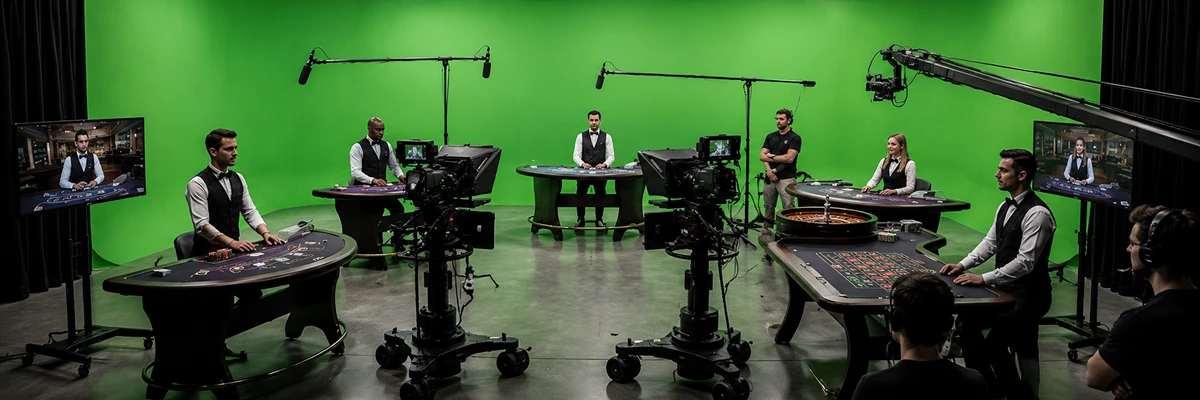
The most important part of Choice Gaming’s current direction is probably not slots or instant games, but live casino through Kiss AI Live Casino. On the official Kiss page, the company describes the product as an AI-first live casino solution where the table, dealer, and visual identity can adapt in real time. Operators are given control over dealer appearance, clothing, background environments, and the overall mood of the live setting, while the core product remains the same.
That is strategically important because live casino has traditionally been constrained by studio dependency. Fixed environments are expensive to build, harder to localise, and slower to adapt. Choice Gaming is clearly trying to challenge that model. The March iGaming Business report says Kiss replaces fixed studio dependency with digitally generated environments and AI-governed dealers, while the January launch coverage described it as AI-first live casino software designed for real-time adaptation. In practice, that means the company is not only selling live content; it is selling a more flexible version of live casino infrastructure.
This could matter to operators for a few clear reasons:
easier visual localisation across different markets
more brand-specific presentation without rebuilding the core table
stronger differentiation inside a segment where many live products still look operationally similar
That does not automatically mean the model will outperform traditional live casino, but it does show where Choice Gaming is trying to position itself: not as a conventional table-game provider, but as a supplier offering adaptable live presentation at scale.
Final thought
Choice Gaming’s strategy looks more coherent than it may seem at first glance. Slots give the company stability, crash and instant games give it speed and flexibility, and Kiss gives it a more ambitious technological angle. The real strength of the model is how these parts connect. Collaborations bring recognisable identity into multiple formats, while AI live casino gives the company a clearer innovation story than a standard content roadmap would. If Choice Gaming can maintain product quality while scaling across these segments, it may become more than just another content supplier. It may become an example of how suppliers use portfolio structure, cultural partnerships, and AI-driven presentation to compete in the next phase of iGaming.

Kendal explores live casino, table games, and mobile platforms, analyzing how digital products recreate real casino experiences and influence player behavior.
More articles in Live Casino & Table Games