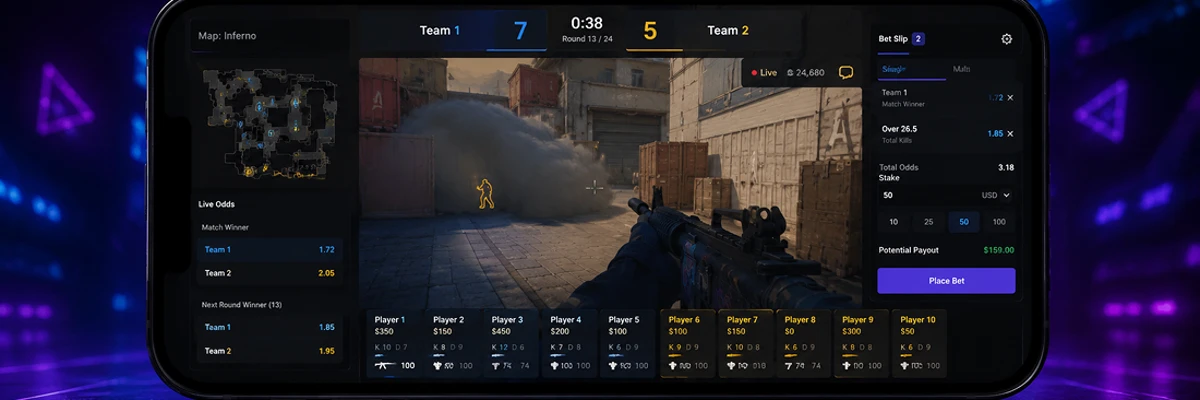
Esports betting has evolved far beyond being a niche side category within online wagering. Over the past few years, the sector has transformed into one of the fastest-growing digital betting verticals, driven largely by younger audiences who consume entertainment differently from traditional sports fans. Modern esports bettors expect fast information, immersive content, seamless interfaces, and real-time interaction. Operators that fail to deliver these experiences risk losing users within seconds.
The rise of esports betting has also changed the way sportsbooks approach engagement. In traditional sports betting, watching a stream and placing a pre-match wager may be enough for many customers. Esports audiences, however, demand more control, more interaction, and more data throughout the entire experience. According to esports betting market research, the global esports betting industry continues to expand rapidly, with analysts projecting multi-billion-dollar growth over the next decade.
One of the biggest reasons behind this growth is demographic change. Millennials and Gen Z bettors dominate esports wagering, and these users are deeply familiar with platforms such as Twitch, YouTube Gaming, and Kick. Unlike traditional bettors, they do not simply watch events passively. They actively engage with streams, communities, player statistics, live chats, and in-game analytics while wagering in real time.
Why Traditional Betting Interfaces Fall Short
The esports audience behaves differently because esports itself is fundamentally digital-first. Fans often know games in extreme detail, understanding strategies, map control, player tendencies, and micro-events that casual viewers may completely miss. This creates demand for deeper and faster betting experiences.
Traditional sportsbook layouts often struggle to meet these expectations. Many still rely on delayed streams, static odds displays, and limited interaction tools. This creates friction, especially when most esports wagers happen live during the action.
Several major trends are reshaping the industry:
Demand for live micro-betting
Multi-screen viewing habits
Real-time statistical overlays
Community-driven interaction
Personalized betting recommendations
Faster in-play market updates
Data from Esports Charts viewership analytics suggests that modern esports audiences consume content across multiple platforms simultaneously, often switching between streams, statistics pages, social channels and live betting interfaces during matches. If a sportsbook forces users to leave the platform to search for information elsewhere, there is a high chance they may never return to complete the wager.
The Push Toward Interactive Viewing
To solve this issue, technology providers are beginning to rethink how esports betting content is delivered. Instead of treating streams as passive broadcasts, newer solutions aim to transform the viewing experience into an interactive environment where bettors can control how they consume information.
One innovation attracting attention is the emergence of customizable viewing tools that allow users to navigate esports matches from multiple perspectives. Rather than depending entirely on the official observer feed, bettors can access more detailed contextual information while remaining inside the sportsbook ecosystem.
This shift mirrors broader changes happening across the entertainment industry. Platforms like Twitch live streaming normalized real-time interaction years ago, and esports bettors now expect the same level of responsiveness from betting operators.
Key Features Modern Esports Bettors Want
Feature | Why It Matters |
|---|---|
Low-latency streaming | Reduces delay between gameplay and betting markets |
Interactive overlays | Keeps betting tools inside the viewing experience |
Player-focused statistics | Helps users make informed live wagers |
Multiple camera perspectives | Improves match understanding |
Personalized recommendations | Increases engagement and retention |
Fast market refresh rates | Essential for live betting accuracy |
One company pushing this concept forward is Oddin.gg, which recently introduced a new viewing solution designed specifically for esports bettors. The platform focuses heavily on interactivity and aims to reduce the disconnect between watching gameplay and placing wagers.
Instead of relying solely on standard observer perspectives, the system enables users to explore different areas of the map and follow players from multiple viewpoints. This creates a much more immersive experience, especially for experienced esports followers who understand tactical gameplay.
Why Engagement Matters More Than Ever
Retention has become one of the biggest challenges facing sportsbooks. Acquiring users through marketing campaigns is expensive, and operators increasingly understand that long-term profitability depends on keeping customers active for longer periods.
This is particularly true in esports betting, where attention spans are shorter and competition between platforms is intense. Younger bettors expect instant access to content, smooth navigation, and constant updates. If a platform feels outdated or slow, switching to another operator takes only seconds.
According to Statista esports audience data, esports audiences continue to grow globally, especially among mobile-first users. This means sportsbooks must optimize not only for desktop environments but also for highly interactive mobile experiences.
Operators that embrace engagement-focused tools are already seeing measurable benefits. Industry reports suggest that interactive streams can significantly increase average viewing times, user interaction rates, and live betting activity compared to traditional streaming environments.
Personalization Is Becoming Critical
Another major development is personalization. Modern sportsbooks are increasingly using behavioral analytics to tailor betting content to individual users.
For example, if a bettor frequently follows a specific Counter-Strike player or team, the interface can prioritize relevant odds, statistics, and live betting options. This reduces friction and helps bettors stay immersed without searching manually for information.
The broader betting industry has already started moving toward personalization technologies. Reports from Gambling Insider industry coverage frequently highlight how operators are investing in user-focused interfaces and AI-driven recommendation systems to improve retention metrics.
Esports betting naturally fits this direction because the audience is already accustomed to algorithm-driven digital experiences across gaming and social media platforms.
Challenges Still Facing the Sector
Despite its momentum, esports betting still faces several structural challenges.
These include:
Inconsistent market uptime
Limited coverage for smaller tournaments
Delayed official data feeds
Stream latency issues
Fragmented betting interfaces
Lack of educational tools for casual users
Many operators still underestimate how demanding esports audiences can be. Unlike traditional bettors, these users often expect near-instant responsiveness similar to gaming platforms themselves.
Additionally, esports titles evolve constantly through updates, patches, and meta changes. This creates ongoing challenges for oddsmakers and trading teams attempting to maintain accurate live markets.
The Future of Esports Betting
The next stage of esports betting will likely focus on deeper interaction and bettor control. Rather than simply displaying odds beside a stream, sportsbooks are moving toward fully integrated entertainment ecosystems where watching, analyzing, and wagering happen simultaneously.
Emerging technologies may soon include:
AI-assisted live insights
Interactive map navigation
Real-time tactical breakdowns
Voice-controlled betting interfaces
Enhanced player tracking
Augmented live overlays
As esports audiences continue to mature, expectations around usability and personalization will only increase. Operators that continue treating esports bettors like traditional sports users may struggle to retain engagement long term.
The esports generation expects betting platforms to feel dynamic, social, and interactive. Success will increasingly depend on providing seamless digital experiences that mirror the fast-paced nature of competitive gaming itself.
With esports wagering projected to grow steadily throughout the coming decade, sportsbooks that invest in innovation now could gain a significant advantage in one of the most competitive areas of the online betting market. The future of esports betting is no longer just about odds — it is about creating an environment where users remain fully immersed from the first round to the final result.
For operators looking to stay competitive, bridging the esports engagement gap may ultimately become the defining challenge of the next era of online wagering.

Focused on sportsbook and esports, exploring market trends, emerging opportunities, and the growth of digital betting platforms. Looks at how user experience and platform design shape player engagement over time.
More articles in Esports & Sports betting