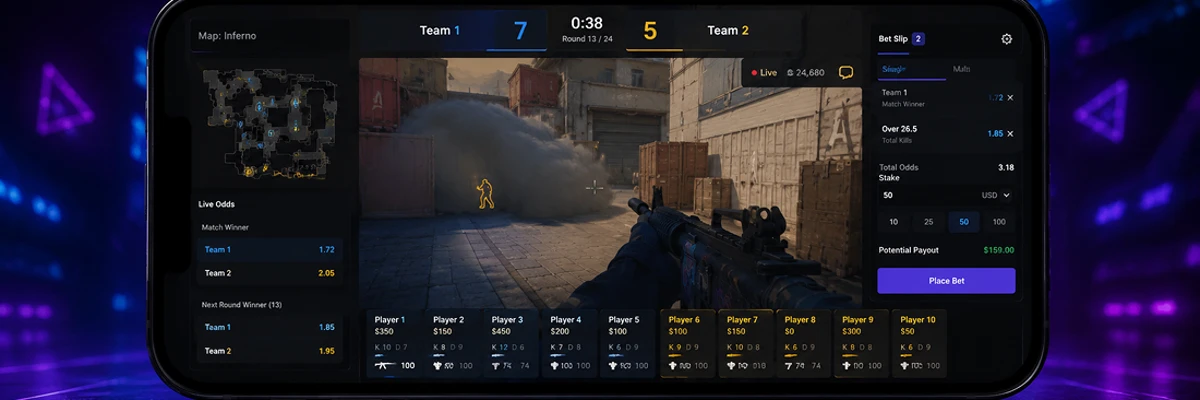
Beyond the Stream: The Future of Interactive Esports Betting
 Elena Korolenko
Esports betting has evolved far beyond simply watching a live stream and placing a wager. In 2025, the competitive edge for operators lies in engagement - not acquisition. As esports audiences are predominantly digital natives, sportsbooks are being forced to rethink how viewing and wagering coexist within the same environment.
According to market analysis from Fortune Business Insights, the global esports industry continues to expand, supported by streaming platforms, sponsorship, and betting-related activity. This broader ecosystem growth creates fertile ground for wagering innovation.
A Digital-First Audience
Platforms such as Twitch and YouTube have shaped how younger audiences consume content — in real time, interactively, and across multiple screens.
Industry insights from Newzoo’s global games market update highlight continued growth in gaming audiences worldwide. This digitally fluent demographic expects immediacy, customization, and control — expectations that naturally extend into betting environments.
Key behavioral traits of esports bettors:
Majority of bets placed live during matches
Strong appetite for in-play and micro-markets
Deep knowledge of specific games and players
Expectation of seamless UI/UX
Unlike traditional sports bettors, esports users often analyze granular in-game developments — map control, economy swings, player stats — before placing wagers.
The Limits of Traditional Streams
Standard public streams offer fixed camera angles and are optimized for entertainment rather than betting. In titles such as Counter-Strike 2 and Dota 2, small in-game shifts can dramatically impact betting odds.
Switching between platforms to check statistics or place bets introduces friction. Each additional click increases the risk of user drop-off — particularly among Gen Z audiences accustomed to frictionless digital services.
Interactive Viewing as Competitive Advantage
The next phase of esports betting centers on integrating content and wagering into a unified interface. Interactive overlays and customizable perspectives allow bettors to:
Navigate in-game viewpoints
Access contextual betting data instantly
Place wagers without leaving the stream
Reduce latency disadvantages
Research from Grand View Research notes that immersive and integrated digital experiences are key drivers of engagement in the esports ecosystem. Betting products that fail to reflect this shift risk appearing outdated.
Engagement tools are no longer enhancements — they are structural necessities.
Market Outlook
While esports betting remains smaller than traditional sports wagering, growth projections remain strong. According to Market Research Future, the global esports betting market is projected to grow steadily over the next decade, driven by technological innovation, broader market access, and expanding audience participation.
Growth Driver | Impact on Esports Betting |
|---|---|
Rising live betting demand | Increased interaction time |
Improved streaming infrastructure | Reduced friction |
Greater market depth | Expanded micro-betting |
Personalization tools | Higher retention |
The competitive question is no longer whether esports betting will grow — it is which operators will adapt fastest.
Putting the Viewer in Control
Esports is inherently more digital than traditional sport. It exists inside data-rich environments where metrics, analytics, and player information are constantly updated. Bettors expect access to that data in real time.
Interactive viewing solutions, contextual overlays, and betting-first interfaces are reshaping expectations. The sportsbooks that succeed in esports will not be those offering the biggest bonus — but those offering the most seamless and immersive experience.
In esports betting, the future lies beyond the stream. It belongs to platforms that transform passive viewing into active participation.
Focused on sportsbook and esports, exploring market trends, emerging opportunities, and the growth of digital betting platforms. Looks at how user experience and platform design shape player engagement over time.
More articles in Esports & Sports betting